
Parker products in the maku Industrie online shop
Inform yourself about Parker products in our catalog section.
We are happy to advise you by phone or e-mail. Send us a contact request.

Parker Hannifin: System Components for Motion and Control in Industry
Parker Hannifin is a global leader in drive and control technology, offering an unparalleled range of components and system solutions. In industrial applications, where absolute leak-tightness, precise control, and seamless system monitoring make the difference between efficiency and failure, Parker products are the first choice. From robust Ermeto tube fittings to intelligent solenoid valves and highly advanced SensoControl diagnostic measurement technology – every component is designed to maximize the performance, safety, and longevity of your machinery and systems. The Parker products offered here form the foundation for reliable hydraulic and pneumatic systems in mechanical engineering, vehicle technology, and the process industry.
Reliable Connection Technology: Ermeto Fittings and Industrial Hoses
The integrity of a fluid power system stands or falls with the quality of its connections. Leaks not only lead to efficiency losses and environmental pollution but also pose a significant safety risk. Parker offers a comprehensive portfolio of connection elements designed for the highest pressures and most demanding conditions.
Ermeto (EO-PSR): The Original Compression Fitting
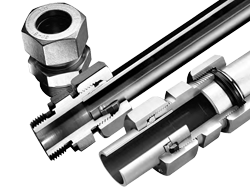
The Parker Ermeto (EO-PSR) compression fitting is the global standard for leak-free tube connections in hydraulics. Its operating principle is as robust as it is ingenious: during assembly, the hardened edges of the cutting ring progressively cut into the tube surface. Simultaneously, the ring is pressed onto the tube by the cone of the union nut. This creates a metallic seal at two points that withstands even extreme pressures, vibrations, and temperature fluctuations. This connection is not only extremely secure but also easy to assemble and process-reliable.
A key feature of the Ermeto Progressive Stop Ring (PSR) fitting is the noticeable increase in torque at the end of the assembly process. This "endpoint" unmistakably signals to the installer the completion of correct installation, thus preventing dangerous under- or over-tightening. The fittings are available in various materials:
- Steel with Cr(VI)-free surface: The standard for general hydraulic applications in mechanical engineering, offering excellent corrosion protection.
- Stainless steel (e.g., 1.4571): Indispensable for use in the chemical industry, food technology, and offshore applications where maximum corrosion resistance is required.
In accordance with the standard DIN EN ISO 8434-1, these fittings ensure worldwide interchangeability and meet the highest quality standards.
Flexible Connections: Hydraulic and Pneumatic Hoses
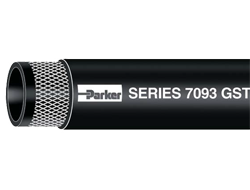
Where rigid pipelines reach their limits, Parker's high-performance hoses come into play. They serve as flexible connections for system components, compensating for movements and dampening vibrations. The construction of a Parker hose is multi-layered and precisely tailored to the application. The inner layer (tube) must be chemically resistant to the medium flowing through it (e.g., hydraulic oil, water, air). Pressure carriers made of braided or spiral steel wire or textile fibers absorb the system pressures. The outer layer (cover) protects the hose from abrasion, weathering, and UV radiation. The selection of the correct hose and the appropriate fitting is crucial for the safety and lifespan of the entire system.
Precise Control and Regulation: Solenoid Valves for Fluids and Gases
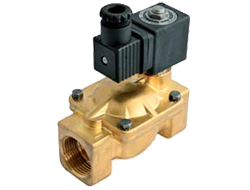
Solenoid valves are the electromechanical actuators in a fluid system. They control, block, or direct the flow of liquids and gases and are thus crucial for process automation. Parker offers an enormous range of solenoid valves for almost every conceivable application, from simple water control to highly dynamic proportional control in hydraulics.
A fundamental distinction is made between different operating principles. Direct-acting valves use the force of the solenoid to directly open or close the valve seat. They switch very quickly and also function at a system pressure of 0 bar. Pilot-operated (or servo-controlled) valves use the existing line pressure to move a diaphragm or piston, thereby opening the main flow. They enable the control of high pressures and large nominal sizes with relatively small solenoids. The choice of the correct valve material (e.g., brass, stainless steel) and sealing material (e.g., NBR, FKM, EPDM) depends on the medium, temperature, and pressure.
Practical Example: Pneumatic Control in a Packaging Machine
The Challenge: An automated packaging plant must erect cartons, insert products, and seal the cartons at a high cycle rate. Various pneumatic cylinders are required for gripping, pushing, and folding movements. The control must be fast, reliable, and in a confined space.
The Solution: A compact Parker valve island is used. It bundles several solenoid valves on a single connection block. This drastically reduces the amount of tubing and wiring. The individual valves are controlled centrally via a fieldbus connection (e.g., Profibus, EtherNet/IP), which connects the valve island directly to the higher-level PLC control. The valves switch the compressed air for the cylinders precisely and quickly, enabling the high cycle times of the machine.
Quality Assurance and Diagnostics with SensoControl
The mere function of a system is no longer sufficient today. Continuous monitoring of system parameters for predictive maintenance and rapid fault diagnosis in the event of a malfunction are required. For this purpose, Parker has developed the SensoControl measurement system. It is a modular system of sensors, measuring devices, and software for recording all relevant physical quantities in hydraulic and pneumatic systems.
With SensoControl, parameters such as pressure, temperature, flow, and speed can be measured and recorded in real time. Robust handheld measuring devices like the "ServiceMaster" are designed for harsh workshop use and enable technicians to perform measurements directly on the machine. Permanently installed sensors can detect pressure peaks, temperature fluctuations, or a decreasing volume flow before a costly machine failure occurs. The collected data forms the basis for condition-based maintenance and optimization of machine performance.
Compressed Air Preparation by Air Preparation Units (FRL)
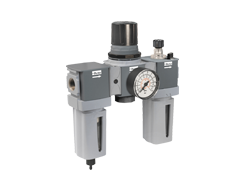
The quality of compressed air is crucial for the lifespan and function of pneumatic components. Unpurified compressed air contains water, dirt particles, and compressor oil, which leads to corrosion, premature wear of seals, and malfunctions of valves and cylinders. The Parker air preparation units, often referred to as FRL units (Filter-Regulator-Lubricator), provide clean and properly conditioned compressed air.
A typical air preparation unit consists of three components:
- Filter: It removes solid particles and condensate from the compressed air.
- Pressure Regulator: It reduces the fluctuating line pressure to a constant working pressure optimal for the application. This saves energy and ensures reproducible processes.
- Lubricator (optional): It adds a fine oil mist to the purified air to lubricate downstream components such as cylinders or compressed air motors. In many modern applications with lifetime-lubricated components, the lubricator can be omitted.
The use of a correctly sized air preparation unit is the most effective measure to ensure the process reliability and availability of a pneumatic system.
Conclusion: Systemic Competence for Your Application
Parker Hannifin's strength lies in the breadth and depth of its product range. The seamless compatibility of fittings, hoses, valves, sensors, and air preparation units enables the construction of highly integrated and reliable complete systems from a single source. By relying on Parker components, you invest in tested quality, technological progress, and the longevity of your machinery and systems. Each individual component contributes to reducing overall operating costs and increasing the productivity of your processes.
Frequently Asked Questions (FAQ)
1. How do I choose the right Parker Ermeto fitting for my application?
The selection depends on three main factors: the tube material, the tube outer diameter, and the maximum operating pressure. For standard hydraulics with steel tubes, the steel version (EO-PSR) is the right choice. For aggressive media or high hygiene requirements, the stainless steel variant must be used. The type of fitting (e.g., straight stud coupling, elbow fitting) depends on the installation situation. Ensure that the pressure rating of the fitting (LL for very light, L for light, S for heavy) is always equal to or higher than the maximum system pressure of your system.
2. What is an air preparation unit (FRL) for, and when do I need a lubricator?
An air preparation unit is essential to protect pneumatic components from damage and ensure stable operation. The filter protects against dirt and water, the regulator ensures a constant working pressure and saves energy. A lubricator is only needed if the downstream components (e.g., older compressed air motors or cylinders) explicitly require lubrication by oiled compressed air. Modern pneumatic components are often lifetime-lubricated and should be operated with unoiled air, as the oil mist can otherwise wash out existing basic lubrication. In case of doubt, the component's data sheet provides information.
3. What advantages does the Parker SensoControl measurement system offer me in practice?
SensoControl enables proactive rather than reactive maintenance. Instead of waiting for a machine failure, you can detect trends through regular measurements or permanent monitoring. For example, a slowly increasing pressure drop across a filter can indicate incipient contamination. Recording pressure peaks can help find the cause of repeated hose ruptures. In short: SensoControl helps you avoid unplanned downtimes, extend the lifespan of your components, and optimize the efficiency of your system, which directly leads to cost savings.