
Order very robust hoses for professionals in every usecase online
Straight hoses, coiled hoses, hose kits and accessories by Parker Rectus for use with compressed air, hydraulics and fluids.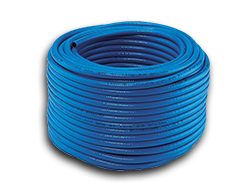
Hoses – Selection, Construction, and Suitable Connection Technology for Industrial Applications
Hoses are connecting elements in machines, control circuits, and systems. They transport media such as compressed air, hydraulic oil, water, coolants, lubricants, or abrasive solid-air mixtures and must meet specific requirements for material, design, pressure resistance, and connection components. Crucial factors include the correct material choice, the appropriate wall construction type, compatible connections, as well as suitable seals and fastenings. In this text, you will find precise technical information on straight hoses, spiral hoses, hose accessories such as clamps, clips, and crimp sleeves, as well as advice on selection, processing, and assembly.Materials and Wall Construction: Properties and Areas of Application
The choice of hose material depends on the medium, temperature, pressure, and stress from abrasion or environmental influences. Polyurethane (PU) is flexible, abrasion-resistant, and ideal for compressed air and vacuum applications with low temperature stress. PVC hoses are cost-effective, chemically resistant to many media, and offer good electrical insulation properties, but lower abrasion resistance. Nitrile rubber (NBR) is preferred for oils and hydraulic fluids due to its oil resistance. EPDM is suitable for high temperature fluctuations and weather resistance, often used in water and steam circuits. PTFE/Teflon is characterized by extreme chemical resistance and temperature stability and is used where aggressive media or high temperatures occur. The wall construction influences the pressure rating, flexibility, and kink behavior. A simple single-layer hose offers maximum flexibility but low pressure resistance. Low-pressure multi-layer hoses combine elastic inner layers and textile-reinforced middle layers for higher pressure absorption. Hydraulic hoses often use textile or steel-reinforced layers for very high operating pressures, as well as a smooth inner chemical-resistant layer. Spiral hoses are designed to return to their original shape after stretching or laying, which is advantageous for hose reels on machines or mobile tools.Connections, Seals, and Connection Technology
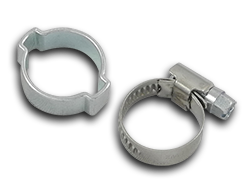
Hose connections determine operational safety. Plug connectors with bayonet or quick-release mechanisms offer quick assembly and disconnection on construction sites, while screw-in and crimp configurations enable permanent, pressure-resistant connections. Crimp connectors are processed with crimp sleeves; they create a permanently gas- and pressure-tight connection between the hose and the metal fitting. When using crimp sleeves, the material pairing, crimp diameter, and crimp force must match the hose wall and fitting to prevent hose slippage and leaks. Hose clamps and hose clips secure the connection at the hose nozzle. Band or clamp types with trigonometric or tight clamping forces are suitable for flexible material systems such as PVC or rubber. For high-pressure applications, special multi-part clamps or fixed screw connections are necessary. NBR seals are standard for oil and air lines, EPDM seals are used in hot water and steam applications, and FKM/Viton offers high resistance to fuels and chemicals. The seal shape, fiber reinforcement, and surface roughness of the connection area influence the sealing effect.Geometry and Form Variants: Straight Hoses versus Spiral Hoses
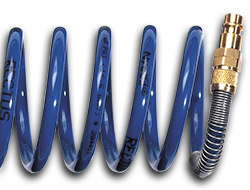
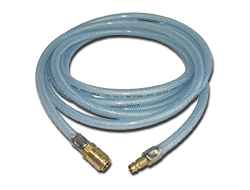
Straight hoses are suitable for fixed installation in linear routing, short movement paths, and applications without coiling. They often offer better flow properties and lower flow resistance. Spiral hoses are designed for mobile tools, automatic retractors, or areas of application with strong longitudinal expansion; they save space, minimize tripping hazards, and are generally designed to be kink-resistant. Spiral profiles can be manufactured open or compact, with open spirals being better ventilated and compact spirals offering higher mechanical stability against abrasion. When selecting, the internal geometry is important: smooth inner surfaces reduce turbulence and deposits, while profiled inner surfaces can be used to reduce weight and material and improve flexibility. For abrasive media, additional inner coatings or wear layers are useful.Practical Application Examples
In an assembly hall, a PU compressed air hose with a crimp connection and O-ring seal is used on a rotary spindle device. The hose is guided in a spiral winding to prevent excess hose length from obstructing tool movements; the spiral shape ensures that the airflow remains constant during retraction and extension. In a hydraulic press, stitched, steel-reinforced hydraulic hoses with banjo or flange connections and FKM seals are used to handle high pressures and oil temperatures with a low probability of failure. In a coolant supply for a machining tool, a PVC hose with a smooth inner surface is used, combined with a stainless steel hose clamp and EPDM seal, to prevent corrosion and material interactions. Another example is the spray painting line: antistatic PU hoses are used there to prevent static charge in powdery media; the hoses are attached to the feed hopper with special crimp sleeves. For mobile repair stations in production, spiral hoses in combination with quick couplings are recommended because they remain compactly coiled and can be quickly connected to the compressor when needed. In sandwich and welding processes, PTFE hoses are used for welding gases because they are chemically inert and leave no residues, while for lubricant lines, NBR hoses with crimp configurations minimize the risk of leakage.Assembly, Testing, and Lifespan
Before assembly, the hose must be checked for length requirements, damage, kinks, and cleanliness. When attaching a crimp sleeve, the crimping machine must be set according to the manufacturer's data. Hose clamps must be positioned so that the force is evenly distributed; for spiral hose routing, sufficient bending radii must be observed so that the layers are not overstretched. Pressure testing after assembly is mandatory: for compressed air lines, typical leak tests at 1.5–2 times the operating pressure, hydraulic lines are often tested 4:1, depending on the standard. Replacement intervals depend on stress, material aging due to UV or chemicals, and abrasion; documented testing routines extend operational safety.Compatibility Testing and Standards
For every hose selection, compatibility with the transport medium must be demonstrated. Chemical resistance lists must be consulted, as well as temperature ranges and permissible operating pressures. Standards such as ISO 1307 (compressed air), ISO 6805 (hydraulic hoses), and national regulations specify pressure classes, test procedures, and labeling. Pay attention to material markings and approvals, especially for food, medical technology, or explosion-hazardous areas (ATEX approvals). For technical documentation, spare parts management, and conformity checks, we recommend standardized article identification and batch traceability. Detailed application examples and technical data sheets can be found at maku-industrie.de/technik, and specific practical cases at maku-industrie.de/anwendungsbeispiele/.Selection Criteria for Purchasing
When purchasing, the maximum operating parameters (pressure, temperature), chemical compatibility, required length and bending radius, and the desired connection type must be primarily defined. Additionally, questions regarding abrasion resistance, UV stability, and antistatic properties need to be clarified. Check whether pre-assembled hoses with tested crimps and seals are supplied or if assembly is done on-site. If there is a particular focus on longevity and ease of maintenance, textile or metallic reinforcements and high-quality sealing materials are preferable. Recommendation points:- Material (PU, PVC, NBR, EPDM, PTFE)
- Construction type (straight, spiral, multi-layer, reinforced)
- Connection technology (crimp, quick coupling, screw connection)
- Seal (NBR, EPDM, FKM)
- Testing and replacement intervals
Care Instructions and Storage
Protect hoses from UV and ozone exposure, store them on rolled spools without kinking tension, and regularly visually check for cracks and detachments during long storage periods. Remove media residues during longer downtimes, as aggressive residual media accelerate material aging. Immediately replace damaged clamps or crimp sleeves, as these can cause leaks and safety risks.FAQ
Which hose materials are suitable for compressed air in workshops?Polyurethane (PU) is the first choice for compressed air: high flexibility, abrasion resistance, and good resilience; PVC is used for more static applications. When is a crimp connection preferable to a clamp?
For higher operating pressures, safety-critical hydraulic lines, or permanent connections, crimping is preferable; clamps are permissible for low pressure and easy disassembly requirements. How do you test the chemical resistance of a hose against an unknown medium?
Compare with resistance tables of the material, if necessary, perform laboratory material tests or short-term tests under realistic temperature and pressure conditions.